
Choosing a tool
Why LCAbyg
LCAbyg is a Danish tool for life cycle assessment of buildings. The new version runs in the browser and replaces the desktop program LCAbyg 5 from 2023. This page sets out what needs to be settled when the calculation is to be used for the climate requirements in BR18: documentation, data, import of quantities, reporting and price.
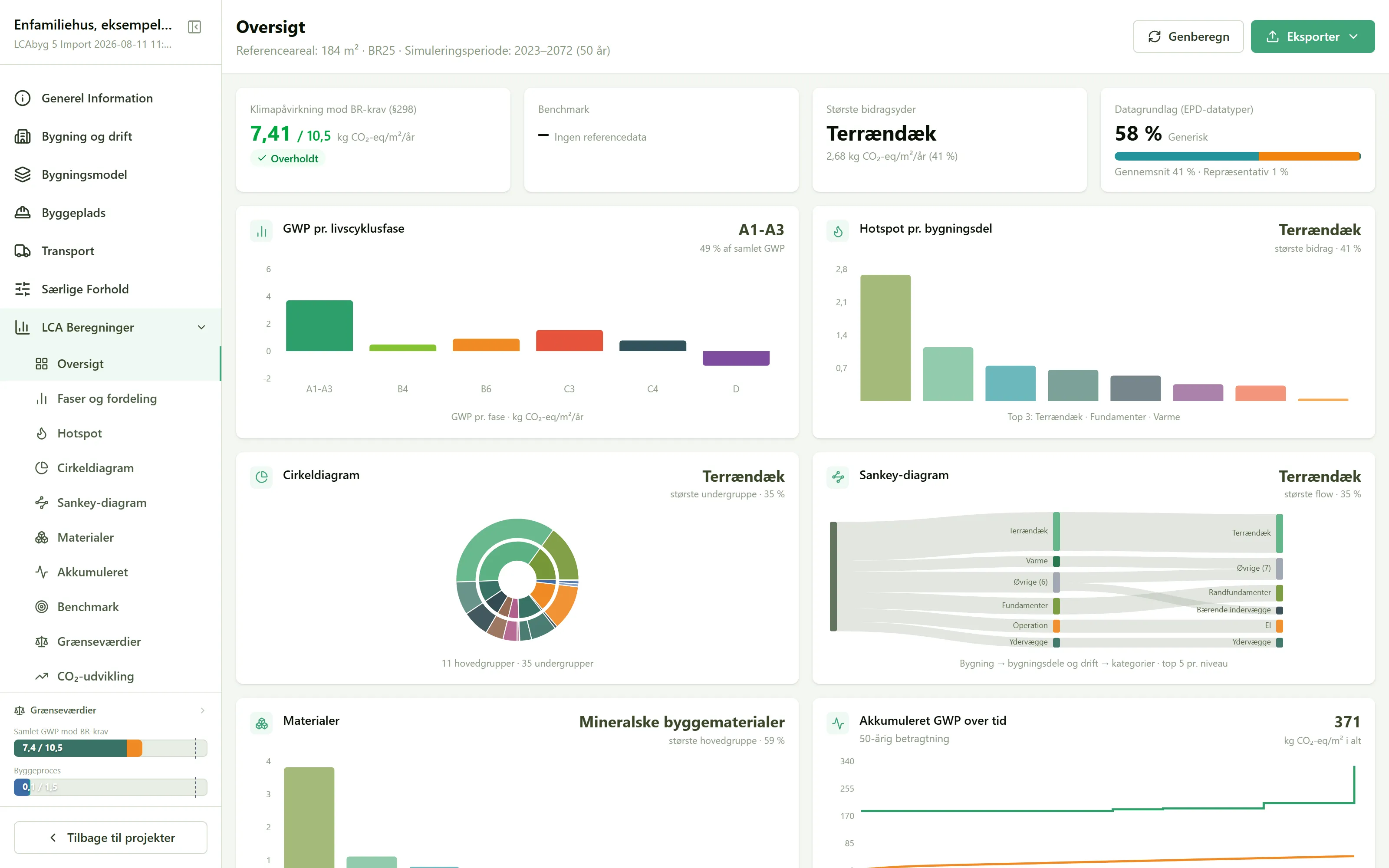
The rules, the limit values and the modules are on the page about LCA calculation under the climate requirements in BR18. BR18 § 297 does not name a program. Climate impact must be calculated according to DS/EN 15978:2012 with the modules and assumptions the regulations set out. Social- og Boligstyrelsen writes that you typically use a calculation program developed for the purpose.
The climate requirements can be documented in LCAbyg
LCAbyg can be used to document the climate requirements in BR18, both the 2023 version and the 2025 version. You enter building elements, materials and energy use. The program calculates the climate impact and shows it against the limit value for the calculation type the project is set up for.
Basis covers calculation according to the Building Regulations and DGNB, with transport (A4), the construction site (A5), key figures, a results table and a limit-value check for § 297 and § 298. LCAbyg is an approved calculation tool for DGNB certification (2023 and 2025) by Rådet for Bæredygtigt Byggeri. The new version supports both via RFBB's toolcheck. For other manuals, contact RFBB about the right version.
LCAbyg 2023 is approved for BREEAM Version 6 and earlier, both International New Construction and Refurbishment and Fit-Out. That applies to the desktop program, not the new web version.
Environmental data from annex 2 and from EPDs
In BR18, climate impact from materials can be calculated with the generic data in annex 2, table 7, or with a relevant and valid environmental product declaration according to EN 15804. There is no requirement that the materials have an EPD. In LCAbyg, generic data is available for each calculation type.
Basis gives access to the shared EPD library and to entering an EPD manually. There is direct access to more than 40,000 EPDs from European programme operators, and they can be used in the calculation without entering the data by hand. Private libraries, import of EPDs into them and sharing within the company belong to Pro.
The official libraries contain both constructions and building products. An error in a library can be reported, so it can be corrected.
Quantities from Revit and from spreadsheets
Import of quantities directly from Revit, from a Revit schedule or from Excel and CSV is in beta. Nothing in the project changes until the import is approved as a new version. On the pricing page, BIM import, a plugin for Revit in beta, is listed under Pro, together with exchanging quantities via Excel. Rhino and Grasshopper have been announced as on the way and are not ready.
Basis includes a quantity export to Excel and upload of projects from LCAbyg 5. A project from the desktop program is imported as an .lb5 file. If the file contains several scenarios, you choose which ones to include, and each chosen scenario becomes a new version. Conversion from the 2023 version to the 2025 version is under Pro.
LCAbyg itself runs in the browser. There is nothing to install. The plugin for Revit requires Windows.
Report, locked version and Excel
The results are gathered in figures. From the project you can make a report in Word and PDF for the client and the municipality, for example at completion. Basis includes submission for the Building Regulations as a locked version, a BR report and Excel. A version can be locked and archived, and documentation can be exported to Rådet for Bæredygtigt Byggeri.
Pro adds several versions of the same project, comparison of versions and projects, hotspot analysis and diagrams. Basis has one working version per project. The package does not include variations, project versions, hotspot analyses or project sharing.
Developed at BUILD, run by LCAbyg ApS
LCAbyg was launched in 2015 by BUILD at Aalborg University, then SBi (Statens Byggeforskningsinstitut, the Danish Building Research Institute). The first version was made for the Danish Energy Agency as part of a building-policy strategy from 2014. On AAU's research portal, the first versions are described as developed by SBi for the former Trafik-, Bygge- og Boligstyrelsen (the Danish Transport, Construction and Housing Authority).
LCAbyg ApS was founded on 20 August 2026. From 1 September 2026 the tool is spun out of the university. The company has a licence agreement with BUILD and is responsible for operations, support and further development. AAU keeps its role as the research environment behind the methods and the knowledge. In June 2026, AAU wrote that the web-based version is to support the climate requirements in BR18 for 2023 and 2025, and that students and participants on LCA courses in Denmark can continue to use LCAbyg free of charge.
Trial, price and help
All paid packages start with a 14-day free trial. No payment card is required. Basis costs DKK 5,900 per user per year, Pro DKK 9,900. Prices are excl. VAT, and the whole company chooses the same package. Students and teachers can create a free student licence. It includes everything in Pro, up to 3 projects at a time, and may only be used for study and teaching.
The desktop program LCAbyg 2023 can still be downloaded. Help for the new version is in the guide at guide.lcabyg.dk and on the support page, where you can write via the form or to info@lcabyg.dk. A walkthrough can be booked as a demo.
Who uses LCAbyg
The About LCAbyg page says that more than 25,000 users have registered since the start. Since the climate requirement arrived in 2023, about 4,500 new users have arrived each year, about half students and half professionals from consultants, architects and contractors. The tool is used in teaching and at consulting firms.
Get started
No payment card required
Frequently asked questions
Does BR18 require the climate calculation to be done in LCAbyg?
No. BR18 § 297 does not name a program. Climate impact must be calculated according to DS/EN 15978:2012 with the modules and assumptions the regulations set out. Social- og Boligstyrelsen writes that you typically use a calculation program developed for the purpose. LCAbyg is such a program and can be used for the documentation for both the 2023 version and the 2025 version.
Can I bring a project across from LCAbyg 5?
Yes. A project from the desktop program can be imported as an .lb5 file. If the file contains several scenarios, you choose which ones to include, and each chosen scenario becomes a new version. Upload of projects from LCAbyg 5 is included in Basis. Conversion of older projects from the 2023 version to the 2025 version is under Pro.
Is import from Revit included in Basis?
No. On the pricing page, BIM import, a plugin for Revit in beta, is listed under Pro, together with exchanging quantities via Excel. Import from Revit, from a Revit schedule and from Excel and CSV is in beta. Nothing in the project changes until the import is approved as a new version. Rhino and Grasshopper are not ready.
What does it cost to try LCAbyg?
The paid packages can be tried for 14 days. No payment card is required. After that, Basis costs DKK 5,900 and Pro DKK 9,900 per user per year, excl. VAT. The whole company chooses the same package. Students and teachers can create a free student licence for study and teaching.
Can LCAbyg 2023 still be used?
Yes. The desktop program LCAbyg 2023 can still be downloaded and used. The new web version does not change existing projects or previous versions.
Sources
- BR18 § 297 and § 298, bygningsreglementet.dk. The calculation follows DS/EN 15978:2012. The section does not name a program.
- Annex 2, table 7, bygningsreglementet.dk. Generic data for materials.
- FAQ on the climate requirements, Social- og Boligstyrelsen. The calculation is typically done in a program developed for the purpose and must follow EN 15978.
- LCAbyg is spun out into a new company, Aalborg University, 18 June 2026.
- The LCAbyg project, AAU's research portal. Start 1 January 2015, developed by SBi for the former Trafik-, Bygge- og Boligstyrelsen.
- About LCAbyg, lcabyg.dk. Launch in 2015, the company, the licence agreement with BUILD and the registered users.
- Product and pricing, lcabyg.dk. DGNB, BREEAM, EPDs, import, reporting and packages.
- LCA ToolTjek, Rådet for Bæredygtigt Byggeri. Test framework for LCA calculation tools for DGNB.
- Guide at guide.lcabyg.dk. Limit values, the EPD library, import, .lb5 and reporting.