
Background and development
About LCAbyg
LCAbyg is a tool that calculates life cycle assessments for buildings.
With LCAbyg you can calculate a building's environmental profile and resource consumption. You enter information about the building elements and, where relevant, the building's energy consumption. The tool automatically handles the LCA calculations and gathers the results into selected figures and a report.
It is calculated over the building's entire life cycle and therefore includes the extraction of raw materials, production of building materials, energy and resource consumption during operation and maintenance, as well as disposal and, where applicable, reuse of building elements and materials.
The company
LCAbyg ApS – a spinout from Aalborg University
LCAbyg was launched in 2015 by BUILD – the Department of the Built Environment at Aalborg University – as a digital reference tool for climate calculations in construction. For more than ten years it has been the industry's shared calculator: in education, at the consulting firms and as the basis for the climate requirements in the Danish Building Regulations.
LCAbyg ApS was founded on 20 August 2026, and from 1 September 2026 LCAbyg is spun out of the university into the new company. The decision was made together with AAU: a university is a research and teaching institution, not an operations organisation for software – and a tool used to document thousands of buildings requires operations, support and continuous updates at a professional level.Read AAU's news about the spinout (in Danish) →
LCAbyg ApS is an independent company with a licence agreement with BUILD. The company handles operations, support and further development of the tool, and users get access through a subscription. Under the licence agreement with Aalborg University, part of the company's surplus flows back into research and helps build better conditions for research in LCA.
Founded by the people who built LCAbyg
The company was founded by the people who developed and ran LCAbyg at BUILD. Together with the developers behind the new web version, they form a team that knows the method, the data and the code from the inside.
- harpa@lcabyg.dk
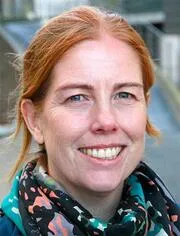 Read moreHarpa BirgisdottirDirector and LCAbyg leadClose
Harpa Birgisdottir
Director and LCAbyg lead
Harpa has led LCAbyg from the very start in 2015, first as grant holder and research lead at BUILD, Aalborg University, and now as director of LCAbyg ApS. She is a professor and head of section at BUILD, where her research for more than 15 years has centred on life cycle assessment of buildings, the climate impact of buildings and embodied carbon. She helped establish the technical basis for LCA now being a fixed part of the Danish building regulations, and has advised the authorities on method and climate requirements throughout. She takes part in the international collaboration IEA EBC Annex 89 on net-zero whole-life carbon in buildings and has published widely on the subject. At LCAbyg ApS she holds overall responsibility for LCAbyg and for the direction of the technical work.
- emilie@lcabyg.dk
 Read moreEmilie Brisson StapelLCA LeadData and EPDsClose
Emilie Brisson Stapel
LCA Lead · Data and EPDs
Emilie has worked on LCAbyg since 2020, first at BUILD and now at LCAbyg ApS. She focuses on the EPDs and generic data behind the calculations, on the environmental impact of building materials, and on end-of-life scenarios for construction and demolition waste. She has analysed EPD data and how it is used in practice, including to prioritise low-carbon building materials. She represents LCAbyg in InData, which is behind the ILCD+EPD format (the digital standard format for EPDs), and in the ECO Platform network. She has published on how EPDs align with the climate requirements for buildings' whole-life CO₂e emissions. Drawing on her insight into how the format is used, she has also contributed to version 1.3, the latest update of the ILCD+EPD format. At LCAbyg ApS she holds professional responsibility for data and EPDs.
- christoffer@lcabyg.dk
 Read moreChristoffer Ole OlsenLCA LeadMethodology and platformClose
Christoffer Ole Olsen
LCA Lead · Methodology and platform
Christoffer has worked on LCAbyg since 2022, first at BUILD and now at LCAbyg ApS. He helped build the Danish generic dataset that the calculations rely on, and he has been behind several of the analyses underpinning the climate requirements in the Danish building regulations. This has included the analytical basis for the climate requirements for both 2025 and the coming 2027 requirements. He has carried out analyses of different building typologies, such as holiday homes and agricultural buildings. He has also documented the calculation method so it can be used in a regulatory context, and has contributed to the Nordic effort to harmonise LCA across countries. At LCAbyg ApS he holds professional responsibility for the methodology and the platform.
 Michael Hartoft-NielsenDevelopermichael@lcabyg.dk
 Morten Munch-AndersenDevelopermorten@lcabyg.dk
Anchored in research
The anchoring in research remains. AAU keeps its role as the research environment behind methods and knowledge development, so the latest knowledge goes straight into the tool. And it works the other way too: LCAbyg users can choose to share their data with research, so BUILD can use it in analyses of the climate requirements in legislation.
The ambition is unchanged: LCAbyg is to be the transparent reference tool that provides comparability, documentation and a shared understanding of buildings' climate impact – now with an organisation that lives by the tool working.
LCAbyg is developed and operated by LCAbyg ApS. Enquiries about the tool, licences and invoicing go to the email address below.
History
Developed at the university 2015–2026
LCAbyg was originally developed by SBi – Statens Byggeforskningsinstitut (now BUILD, Aalborg University) – with financial support from a range of stakeholders in Denmark.
Development originally drew on an Excel tool that BUILD developed for Green Building Council Denmark's DGNB certification of buildings in Denmark. The first version of LCAbyg was launched in 2015 for the Danish Energy Agency, as part of a construction policy strategy from 2014, in broad collaboration with a wide range of stakeholders in the Danish construction industry.
Since then, both small and large changes have continuously been made to LCAbyg, and the user interface and calculation core are now on version 6. Since the start, more than 25,000 users have registered – and since the climate requirement took effect in 2023, around 4,500 new users a year, roughly half students and half professionals from consultancies, architects and contractors.
Development at the university was funded by a range of stakeholders – most recently Villum Fonden and Realdania until the end of 2025. After that the tool had to stand on its own, which is the background for LCAbyg ApS.
Previous versions of LCAbyg were funded by
- Villum Fonden and Realdania
- BUILD, AAU (formerly Statens Byggeforskningsinstitut)
- The Danish Energy Agency, the Danish Transport, Construction and Housing Authority, the Danish Housing and Planning Authority
- Elforsk
- Green Building Council DK (Rådet for Bæredygtigt Byggeri)
- Grundejernes Investeringsfond